
Hair loss is one of those things people suffer through quietly for years before they do anything about it — partly because the options feel either too medical or too uncertain. Minoxidil, the pharmaceutical, works but comes with a lifetime commitment and a list of side effects some people find intolerable. Natural alternatives have always existed but were largely dismissed as wishful thinking until a 2023 clinical study changed the conversation significantly.
This is what that study actually found, why it matters, and what it means for how you care for your scalp.
The study
In 2023, a randomized controlled trial published in Skinmed Journal compared rosemary oil directly to 2% minoxidil solution for androgenetic alopecia — the pattern hair loss that affects both men and women. Participants applied either rosemary oil or minoxidil to their scalp twice daily for six months. Hair density was measured at baseline, three months, and six months.
The result: rosemary oil produced comparable hair density results to minoxidil at the six-month mark. Both groups showed significant improvement over baseline. The rosemary group reported fewer scalp side effects — specifically, less itching and irritation than the minoxidil group.
This wasn't a fringe wellness study. It was a peer-reviewed, controlled trial with a pharmaceutical as the comparator. That's a meaningful bar.
Why rosemary? The mechanism
Rosemary's effect on hair isn't folklore — it's documented at the cellular level. The active compound responsible is rosmarinic acid, which works primarily by improving scalp circulation. Better blood flow to the hair follicle means more nutrient and oxygen delivery to the cells responsible for hair production.
The other mechanism is DHT inhibition. Dihydrotestosterone (DHT) is the androgen most directly linked to androgenetic hair loss — it miniaturizes hair follicles over time, leading to progressively thinner, shorter growth cycles. Rosemary has demonstrated mild DHT-inhibiting properties in laboratory research, which gives it a two-pronged approach: stimulating the follicle through circulation while reducing the hormonal signal that suppresses it.
Minoxidil, for comparison, works almost exclusively through vasodilation — widening blood vessels to increase scalp blood flow. Its mechanism and rosemary's principal mechanism are essentially doing the same thing through different means. This is likely why the outcomes were comparable.
What it doesn't mean
This study is promising, not conclusive. One trial is not a body of evidence, and it's important to be honest about that. The sample size was relatively small. Androgenetic alopecia is one type of hair loss — this research doesn't speak to alopecia areata, stress-related shedding, or hair loss from nutritional deficiency. Those are different conditions with different drivers.
Rosemary oil is also not a replacement for medical advice if you're experiencing significant hair loss. A dermatologist can determine the cause and whether pharmaceutical intervention is the appropriate first step. Natural ingredients work best as part of a consistent preventive or supportive routine, not as emergency treatments for acute loss.
What this study does mean is that the dismissal of rosemary as "just" a herb with no clinical backing is no longer accurate. The evidence exists. It's peer-reviewed. And the side effect profile is meaningfully better than the pharmaceutical alternative.
How we use it in The Comeback
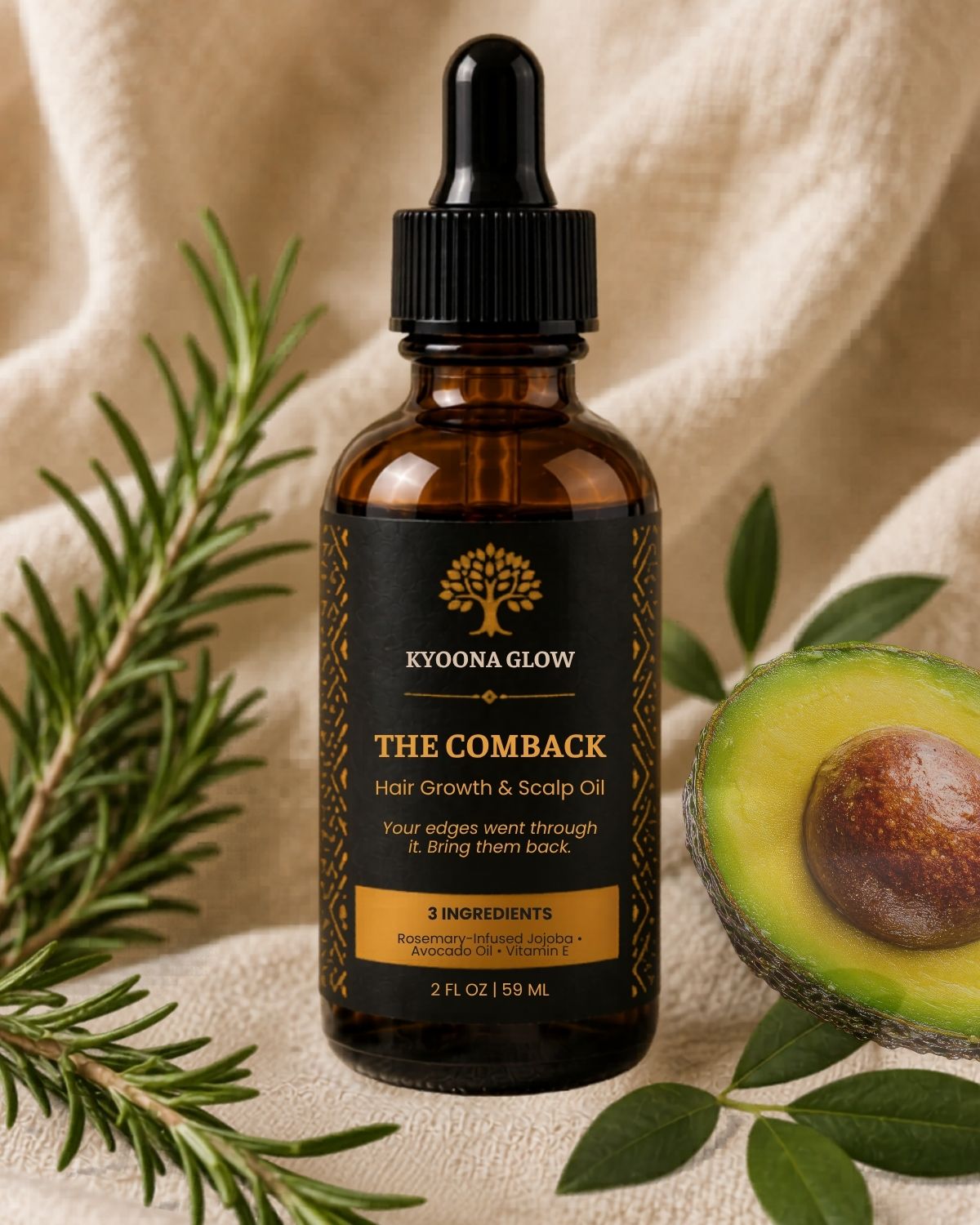
The Comeback — our Hair Growth & Scalp Oil — is built around rosemary-infused jojoba. We slow-infuse dried rosemary into jojoba oil over several hours to draw out the rosmarinic acid and fat-soluble compounds into the carrier. This is different from adding a drop of rosemary essential oil on top of a carrier — the infusion process extracts a broader spectrum of compounds and creates a more stable, more bioavailable final product.
Jojoba was chosen as the carrier deliberately. It is technically a liquid wax, not an oil, which makes it exceptionally stable and long-lasting. It's also chemically similar to human sebum, meaning it's recognized by your scalp as compatible rather than foreign. It absorbs without heavy residue — important for a scalp product that needs to actually reach the follicle rather than sit on the surface.
The formula is the rosemary-infused jojoba plus vitamin E tocopherol. Three ingredients in the infusion, two in the final bottle. Nothing else.
How to use it for real results
Scalp oils work through consistency, not volume. More product applied infrequently will do less than a small amount applied regularly.
Apply The Comeback directly to the scalp — not the hair shaft — using the dropper. Section your hair if needed. Massage with your fingertips for 2–3 minutes. This isn't just good ritual practice. The massage itself mechanically stimulates scalp circulation, compounding the effect of the rosemary.
Use it at least three times per week. Daily is better. The 2023 study used twice-daily application, which is the research standard — real-world consistency looks more like three to five times weekly for most people.
Expect to wait. Six months was the study timeline for meaningful results, and that's a realistic window for you too. Hair growth cycles are slow. The follicle has to wake up, produce a new hair, and grow it long enough to be measurable. This is a commitment, not a quick fix.
The good news is that you're not waiting for the results to feel the product working. Within a few weeks most people notice less scalp tension, reduced flaking, and overall improved scalp condition — because a well-nourished, well-circulated scalp feels different even before the hair count changes.
The bottom line
The research is real. The mechanism is understood. The results at six months matched a pharmaceutical that has been standard treatment for decades, with a better side effect profile. That's a meaningful thing to be able to say about a plant-based ingredient.
It's also still a plant-based ingredient, which means it requires patience and consistency rather than the dramatic early results some pharmaceuticals produce. That's the honest trade-off.
If you're in the early stages of noticing your hair thinning, or you want a scalp routine that supports long-term follicle health before loss becomes acute — rosemary-infused oil, applied consistently, with a real massage, is one of the most evidence-backed choices you can make right now.
The Comeback was built for exactly that.